
Background
OTDR (Optical Time Domain Reflectometer) is the primary tool for fiber link characterization, fault detection, and maintenance in telecom and enterprise networks. However, a single OTDR can only test one fiber at a time — deploying dedicated OTDR units for every cable in a multi-fiber network is costly and inefficient.
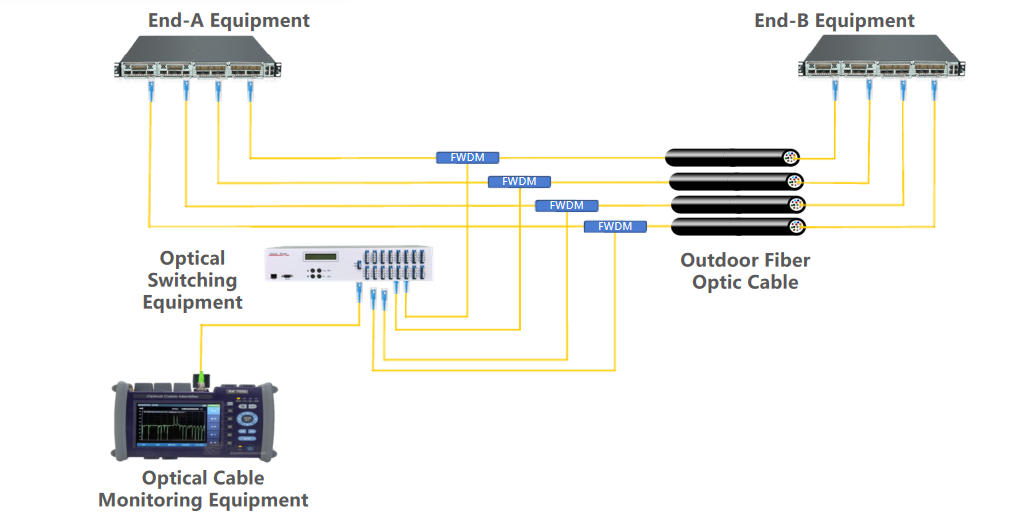
An optical path selector (1×N optical switch) shared between multiple fiber routes and a single OTDR dramatically improves equipment utilization while enabling automated, round-the-clock network monitoring.
System Architecture
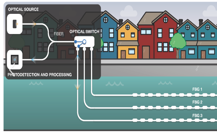
The control unit connects to both the OTDR and the optical switch. It initiates path selection to switch to the fiber under test and performs an OTDR fiber performance roll-call test. Through timed polling, the control unit directs the OTDR and optical switch to conduct periodic testing across all monitored cables on a scheduled basis.
Analysis of the OTDR trace (reflectogram) identifies the alarm type — such as fiber break, high-loss splice, or connector degradation — and pinpoints the alarm location along the fiber route.
Key Benefits
- Higher OTDR utilization — One OTDR sequentially monitors dozens of fiber routes, reducing capital equipment cost.
- Automated roll-call testing — Control unit initiates on-demand or scheduled fiber performance checks across all connected cables.
- Timed polling — Periodic automated testing detects degradation before service impact occurs.
- Alarm identification & localization — OTDR curve analysis determines alarm type and exact fault location.
- Fast optical switching — MEMS switch technology enables rapid path changeover between monitored fibers.
- Remote network management — Integration with NMS for centralized monitoring, logging, and alarm reporting.
Operation Modes
- On-demand roll-call — Control unit switches to a selected fiber and triggers an immediate OTDR performance test
- Timed polling — Scheduled sequential testing of all connected fiber routes at configurable intervals
- Alarm-triggered test — Automatic OTDR re-test on a specific route when power monitoring detects an anomaly
Typical Deployment Scenarios
- Carrier fiber backbone multi-route monitoring
- Data center fiber infrastructure health checks
- Enterprise campus and metro network maintenance
- Pipeline and utility fiber route periodic inspection
Recommended Products
WXG Optics provides GY-1×N MEMS optical switch modules for optical path selection (1×4 to 1×256), and ROSW-1×N rack-mount systems for centralized multi-cable monitoring stations. Contact us for OTDR integration support.