
Background
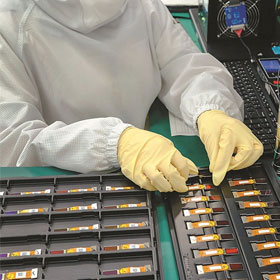
Optical component and module manufacturers rely on automated test systems to verify insertion loss, return loss, polarization, and channel performance across large product batches. As port counts grow and test sequences become more complex, manually re-patching fiber connections between devices under test (DUTs) and shared test instruments becomes a bottleneck.
M×N matrix optical switches address this by programmatically routing optical paths — allowing one set of test instruments to serve many DUT ports without physical reconnection.
System Architecture
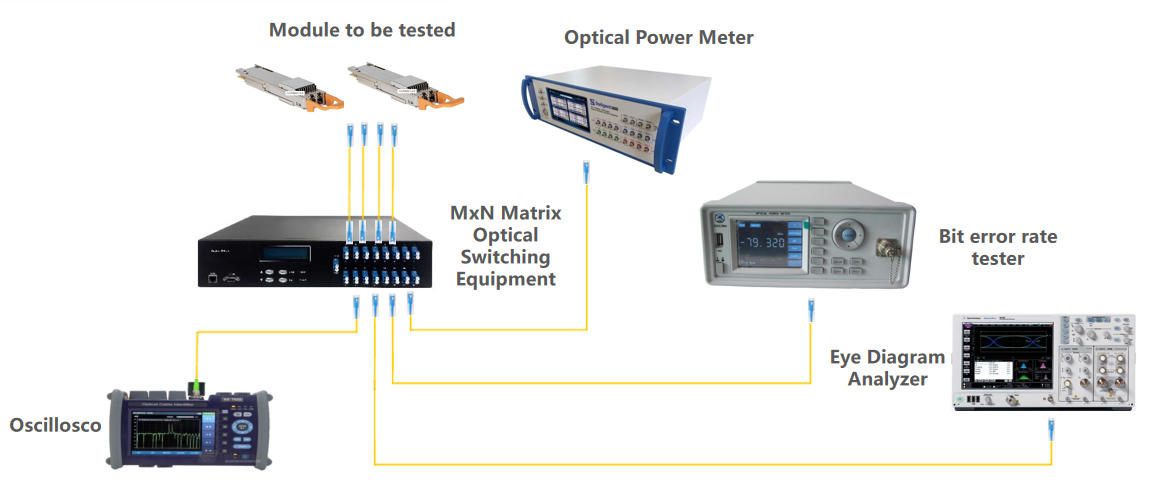
In a typical automated optical test setup, the M×N matrix switch sits between the DUT array and shared test equipment such as tunable lasers, power meters, OTDRs, or BER testers. Control software selects the desired input–output path for each test step, enabling fully automated multi-port characterization.
Key Benefits
- Higher instrument utilization — One laser or power meter can sequentially test dozens of ports, reducing capital equipment cost per test station.
- Faster throughput — Automated path switching eliminates manual fiber re-patching, cutting cycle time on production lines.
- Flexible matrix configurations — 1×4, 1×8, 2×2, 4×4, 8×8 and custom M×N layouts adapt to different DUT port counts.
- Low insertion loss & fast switching — MEMS technology delivers ≤1.6 dB IL and ≤15 ms switching, preserving measurement accuracy.
- Easy integration — RS232 and Ethernet (RJ45) interfaces connect directly to existing test automation frameworks.
Typical Test Scenarios
- Multi-channel optical module burn-in and qualification
- PLC splitter and WSS device characterization
- Fiber patch cord and connector batch testing
- Production-line IL/RL/PMD verification with shared reference instruments
Recommended Products
For automated test system integration, WXG Optics offers the M×N Matrix FSW Series with flexible matrix configurations, low insertion loss, and standard electrical control interfaces. OEM customization is available for specific port counts and form factors.